A gift of clear sight. Holly. Tree-type series 125
This Piece is part of an ongoing monthly series exploring Trees as living teachers in correspondence with Enneagram patterns, seasonal cycles and human experience. First published on Substack
Tree: Holly
Moon: Snow Moon
Archetype: Enneagram 125 – ‘The Mentor’, (Katherine Fauvre). Also 152, 251, 215, 512, 521.)
Virtues: serenity (1) humility (2), non-attachment (5)
Holy ideas: holy perfection (1) holy faith (2) holy transparency (5)
Some rings of fire: tolerating shadow, asking for help, close contact.
It is mid-January and a mixture of icy clear sunny days, sideways sleeting rain, and bleak fog. The festivals of light are behind us and here in South England it feels more wintery than it did before they lay ahead of us. With this moon I hope to bring you some hope, in the form of another very seasonal tree. I hope to bring you something of the spirit of Holly.
Woman: I ask you Holly, what you say to me?
I ask you Holly, how you stand so free?
Next to me as I write I have a sprig of a variegated holly from my garden, with prickles on both its edges and the top of its leaves, and I have lit a candle to create some temenos around this writing. As you can see there is a wooden candle stick on the table top too It is made from Olive wood, which was the tree I walked with last month. Olive and Holly are both trees I have come to know as resilient and of deep strength and care for us humans.
So, the baton is being passed!
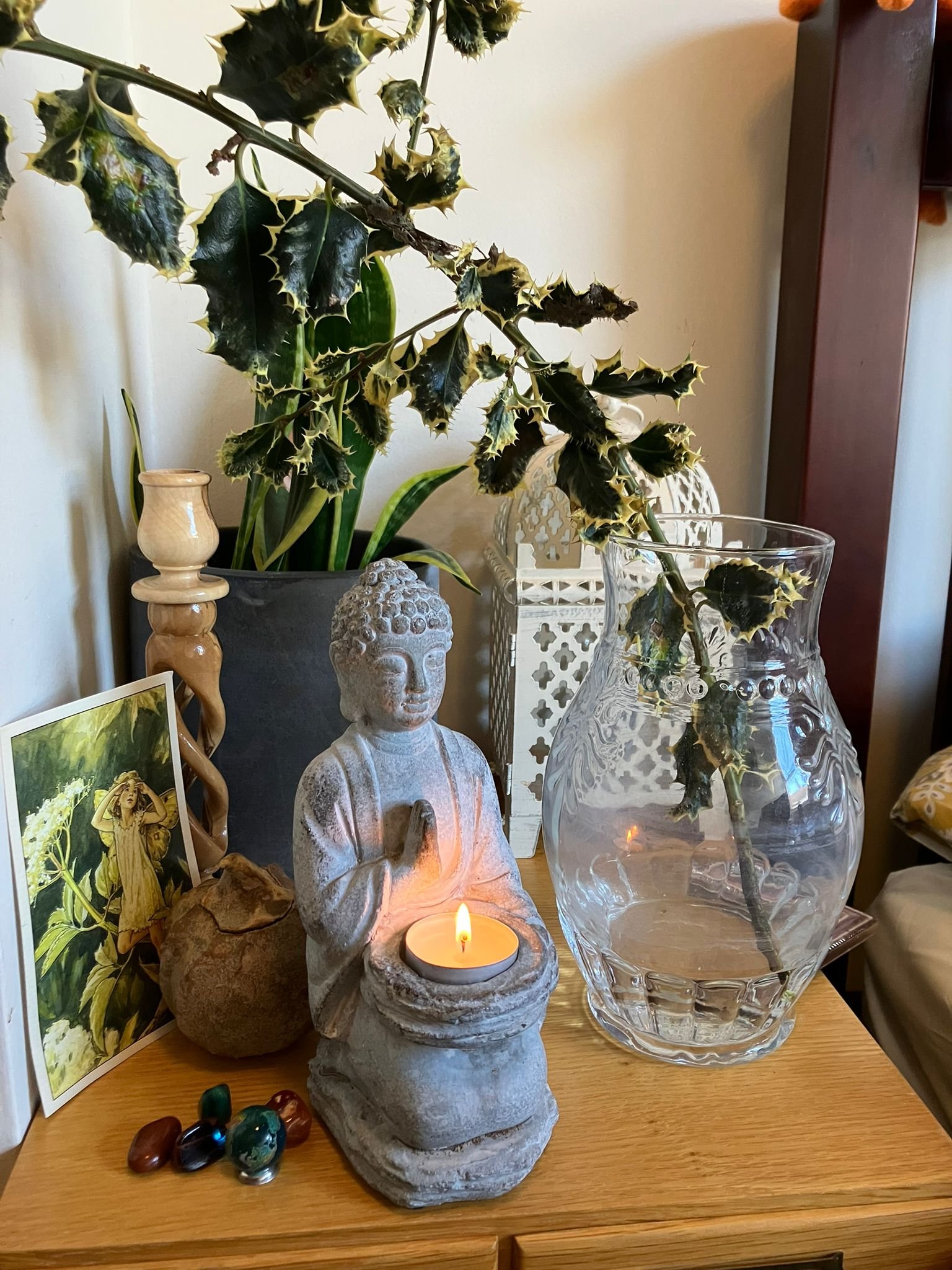
Each month, in this tree-type series, a tree steps forward as companion and teacher, and with the Snow moon, Holly takes their place.
Holly: I tell you that all living happens here.
Not in your head nor in your sorry heart,
but out on heath where action makes things true.
The life not lived is pent up berry space.
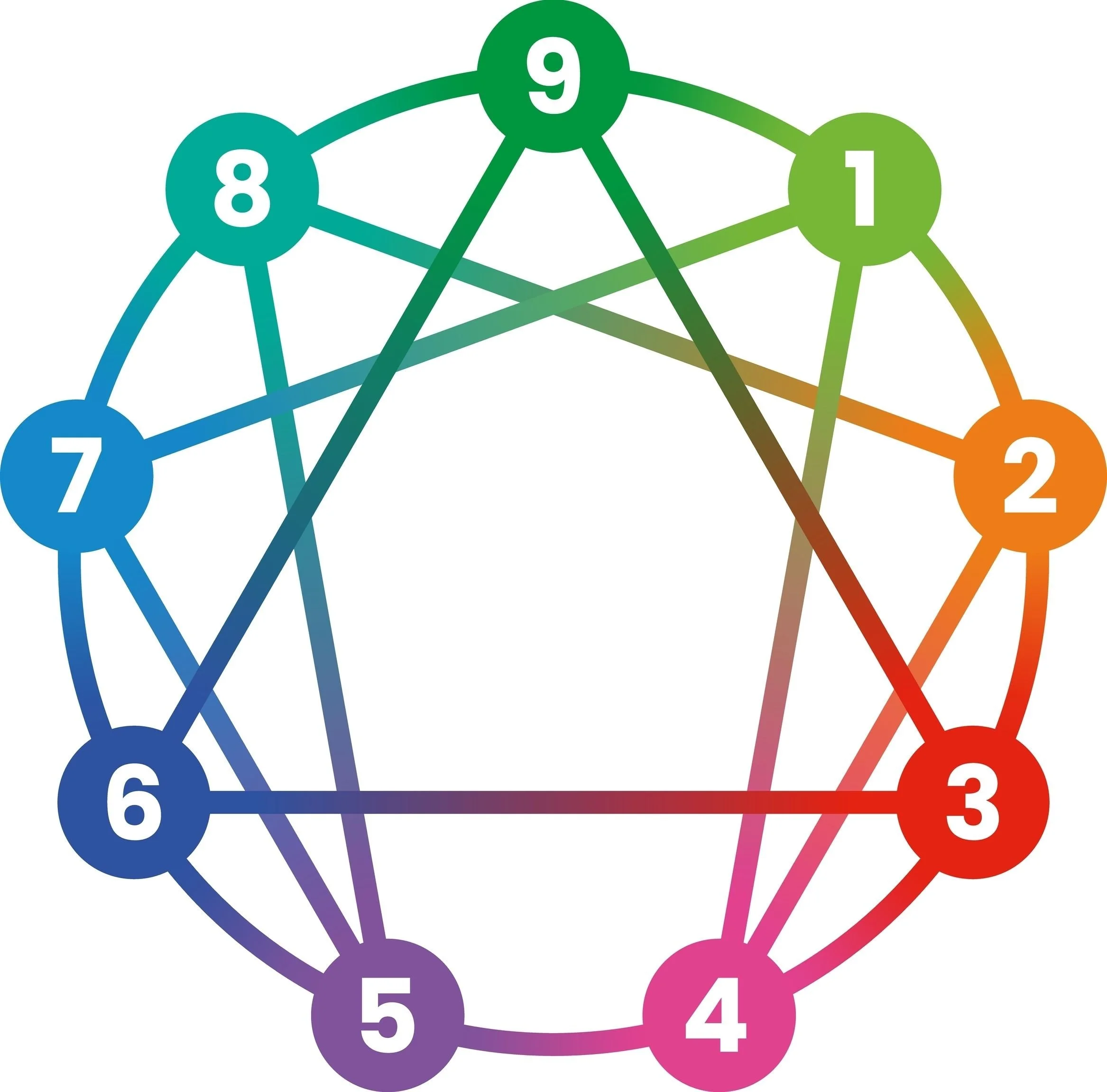
As this project unfolds, I’m increasingly aware of how certain trees seem to step forward at different times. I’m also working with the Enneagram symbol1 and its three-centred patterns2 as archetypes.
I’m learning that they express in imagation and in humans with dynamic lifeforce and potential for inspiring our contribution to the unfolding human story.
Each time a tree pairing comes into clearer focus, and someone is willing to speak honestly from within the Enneagram pattern they live, my sense deepens that trees are our active allies in our human journeying. They offer a way of understanding how these personality patterns can serve the wider whole when they are allowed to relax and come into balance. For me it is then that they reveal to us both their mythic dimensions and their pragmatic possibilities for living in the world.
It was in this way that meeting with Mary on Zoom recently felt like a precious gift. Mary identifies with a 5–2–1 Enneagram pattern, and living with the five pattern, she carries a natural awareness that time and energy are precious resources. I was keen to honour that — just as I wish to honour yours now.
My task here is to show how the Holly tree mirrors this pattern, and how it can resource us in much the same way that a healthy 1–2–5 configuration (the order of the numbers doesn’t matter) offers its particular, vital service to the unfolding human story.
Mary helped the Holly pattern to come into clearer relief as lived intelligence.
Holly: You are berry. You owe heath your living.
That is all, your living is enough here;
your small red burst of creation is writ.
My sharp pricking leaf asks you to prove it.
Our indigenous holly in the UK and across Europe is Ilex Aqua folium, and it is a very iconic tree here culturally and mythically, especially associated with the darker months of the year and with Christmas.
There are around 480 kinds of holly worldwide, including American and African Holly. Asia has 200 kinds of indigenous Holly. Holly is a very ancient tree, and it is quite possible that it emerged while dinosaurs were still on the earth. The clearest fossil evidence from holly is from Palaeolithic time – 66 million years ago. This makes Holly an incredible survivor.
Walking in the New Forest in Hampshire, just before lock-down was declared at the beginning of the Covid pandemic, I was in a heightened state, feeling a kind of surrealness as we took a walk, knowing it might be the last one we took in a while.
There was little traffic on the roads, and an ice-cream van where people stood shivering in the car park in a very British way, and it felt like a fragile sign of a swiftly disappearing normality.
The New Forest is not actually all that foresty – there is a lot of heathland, covered with gorse (an incredible shrub for another time).
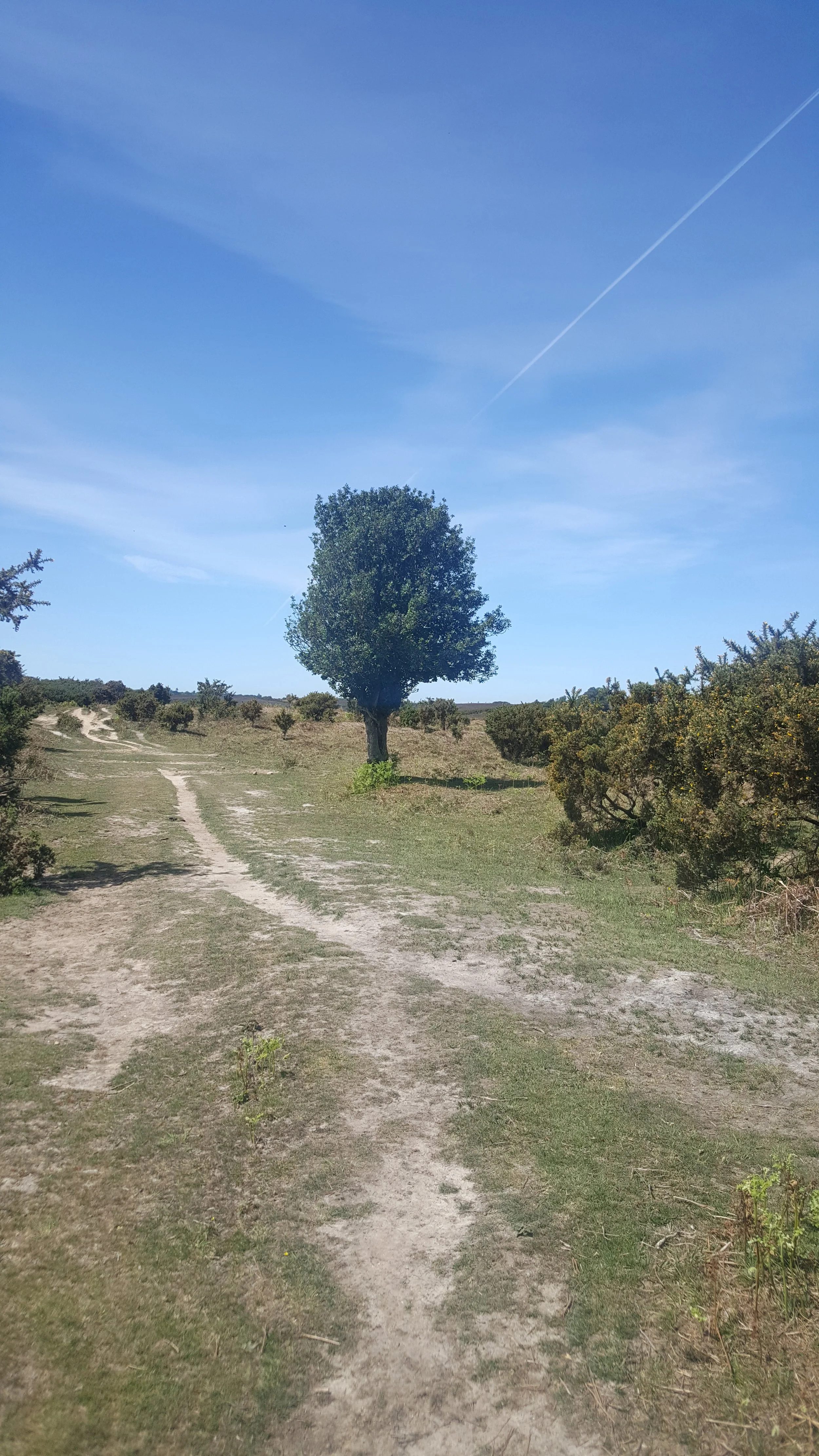
My mentor the Holly in the New Forest near Brockenhurst.
As we were wandering in and out of the endless gorse, just above human height, all of a sudden, we rejoined the path and I was confronted by this Holly tree, like a warrior ahead of me. And I can say that that moment changed my life and the trees changed for me forever.
At the time, which was early in 2020, I had just begun a Facebook group with friends willing to explore with trees following a Celtic calendar outlined by Sharlyn Hildago3, based on the Oghan, an ancient tree alphabet.
We were three trees in, exploring Ash, when Covid arrived, I had the walk Im telling you about and Holly appeared, out of order! And so, I waited and posted this a few months later in May, when it was our turn with Holly.
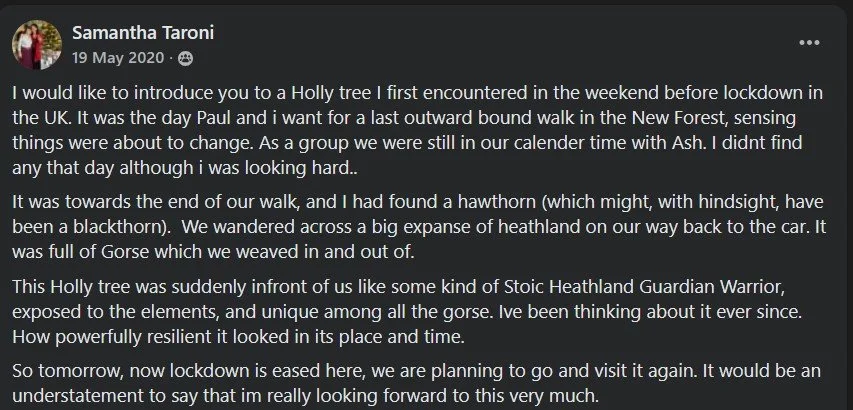
Out on the heath exposed to the elements, with sky as canopy, the Holly struck me with its stoic presence. It appeared fearless to me. I know, as an enneagram six, that fear is not innate, but rather forged by finding way through difficulties that life presents, and that the tree was stoic because of its presence in, and commitment to, its habitat; the heath.
Later on in the Covid epidemic, during a second lockdown, I was navigating a medical issue remotely without face to face healthcare and I turned again to the Holly for courage.
The words of the poem I wrote, about the conversation and the ritual I found to help me connect with Holly, are woven through this piece of writing.
Katherine Fauvre calls the 125 pattern ‘The Mentor’ and I have used that name too. There are important ways a mentor is different to a guide, and this distinction is important. A guide might help you to navigate specific experience or terrain, while a mentor supports your long-term development. They may advise, and they will often reflect, challenge and model growth. Their view is more panoramic than the witness of a guide, and a mentor will model and uphold core values which they will have refined and integrated into their presence.
Holly does not lead us step by step. It is their living presence that embodies mentorship.
It is in their stoic witness to to life that Holly, and the integrated holly human, meet us and inspire us.
Holly: Make this pact with me. Make this pact with me.
You ask me, Holly, what I say to you?
Make this pact with me. Make this pact with me.
The living must return and start anew.
In overseeing the three patterns moving in the 125 pattern, we see a human with a strong sense of moral duty (1) who values relationships highly (2) but with a reserve of detached thoughtfulness and respect for boundaries and privacy (5).
There is a tension build into this between the warmth and emotional need of the two and the mindful detachment of the five. They have different ways of relating.
In any of the three-centred enneagram patterns with the one as the body pattern, there will be a theme of needing to find an alignment with what is the right way to be; the right thing to do. Like an internal arrow pointing upwards - a vertical spirit level.
This is likely to guide the 125 human when it is time to act, and might even become the trusted mediator between the needs of the two and the five.
For more about the expressions of the body centre in all the 27 three-centred enneagram patterns, you might enjoy this recent post.
Mary works as a coach and she spoke of her love for her clients and how she partners with them in working towards their goals. She also told me that she has been given the feedback ‘I feel like with you theres nowhere to hide’ and in this we can see something more of the dynamically different faces of this archetype.
My sense is that when this archetype is integrated it really sees other people clearly, and with a powerful and deep no-nonsense kind of love that really wants them to discover what is best for them.
I also had the sense, meeting with Mary, that this would be a calm and consistent experience, and something that the more reactive and assertive types (3,4,6,7,8) could really benefit from. That these qualities of clarity (1), care (2) and spaciousness (5) can help others in finding into more balance and gravitas, and into stronger discernment of what is right and what is wrong in their lives.
Connecting with the integrated 125 can inspire contact with our own inner compass.
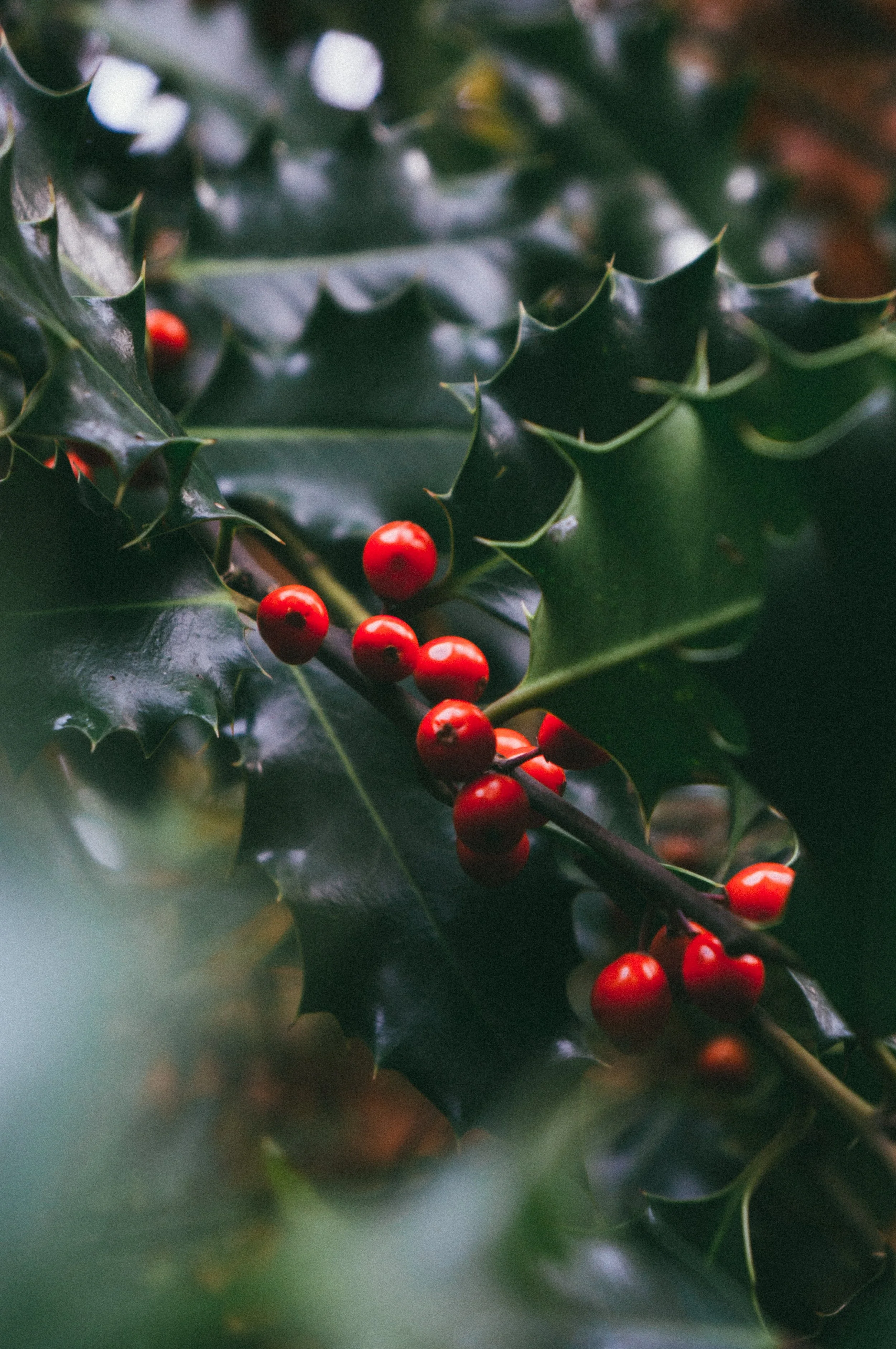
Holly -Ilex Aqua Folium: : Tobius Tullius
In a culture that can exhaust us with its demands for constant productivity, Holly offers us a different intelligence.
Notice the high polarity in Holly: the bright red berries, the dark waxy evergreen leaves. Imagine this tree in the scene of deep winter snow, when its berries are full in their shiny clusters, and you will behold a striking presence.
There is a lot of visual polarity built into the wintering Holly: As it resources the birds with its berries and small animals might shelter beneath it, it is also highly protected by its complex lower spiky leaves, evolved to deter larger grazing mammals that might munch on it.
But look up. Above grazing height, the holly doesn’t waste its time on creating prickles. These higher leaves are smooth and simple. This is the gift of enneagram five too; an innate understanding of how to conserve energy and to use it efficiently.
In holly and in the evolving 125 there is an intelligence as to when and how to use boundaries for protection, and when to allow for healthy resourcing and loving connections.
Red and green; spiky and smooth; sheltering and self- protecting; Stoic and sensitive to context. Holly holds all of this within its scope and so does the 125
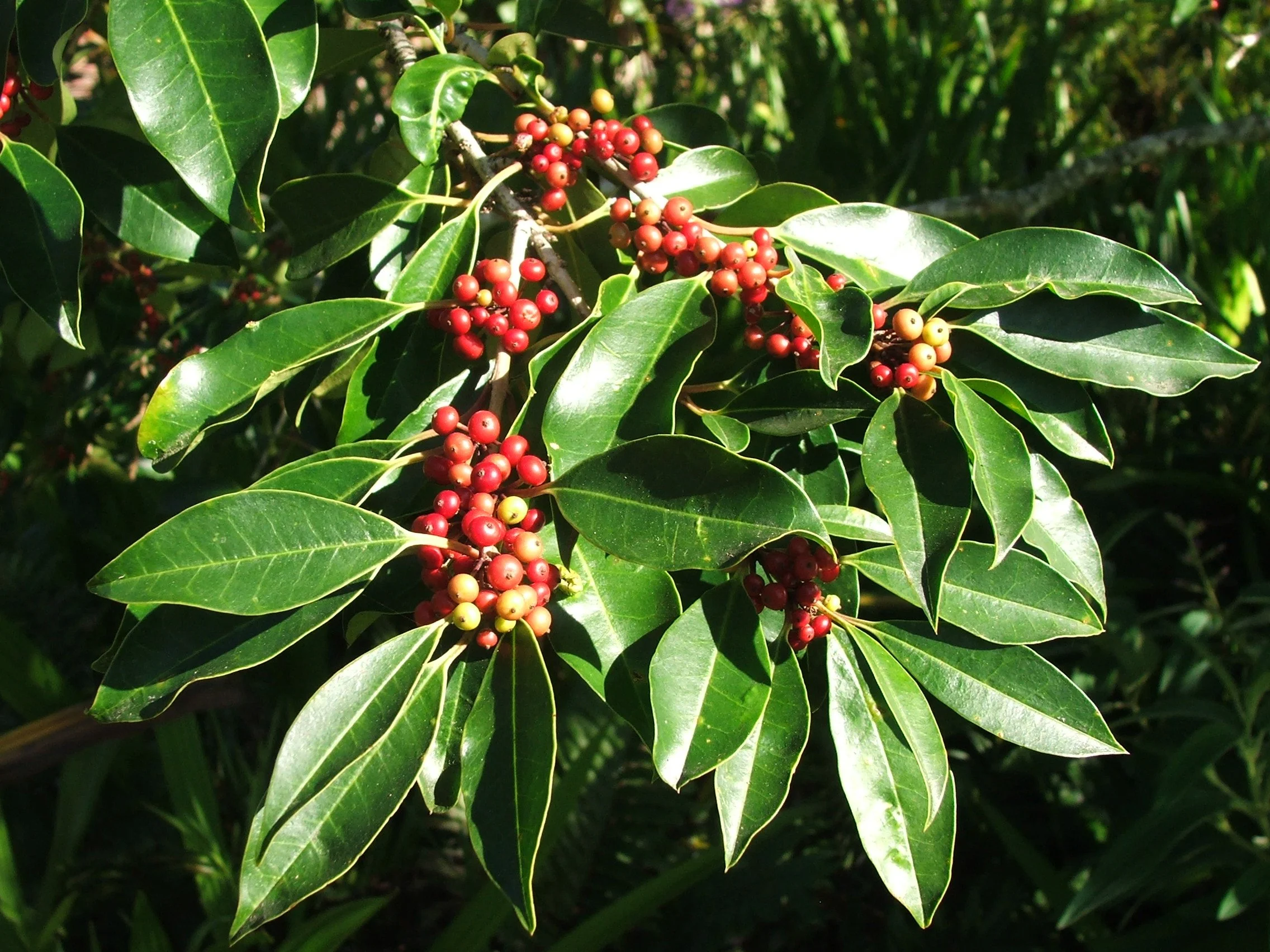
African Holly, Ilex mitis
No piece about holly would be whole without entering the realm of berries. To make berries, a Holly tree must put an intense concentration of its energy and fold it up tight into these hard red rounds. These striking shiny fruits will attract the thrushes and the starlings, the deer and the squirrels, who will go on to spread the seeds in the heart of the berries and ensure Holly’s legacy.
Berry-making takes a lot out of a tree and after a year of creating many berries, a tree will take a quieter year and rest back, after working hard. This has been a highly fruiting year for the Holly here in England, supported by the conditions of a mild spring so that the insects could pollinate well between the male and female Holly trees. So there will be a surge of new holly trees to come that found their ground this past year.
This pacing that nature understands well is not encouraged in systems that exploit others energy without concern for their well-being, and healthy humans and human environments understand the need for pacing and recovery inbetween our phases of generativity.
This kind of practical knowledge is a gift embodied by the Holly. As an evergreen, and a prickly evergreen at that, the holly has found a way to weather winter, and to choose when and where it puts its energy. Holly models both measure and consistency.
Woman: I see you Holly, hear your words to me.
You stop me in my tracks majestically.
I prick my thumb and make my berry there.
My life is now on my thumb before you.
The living must return and start anew.
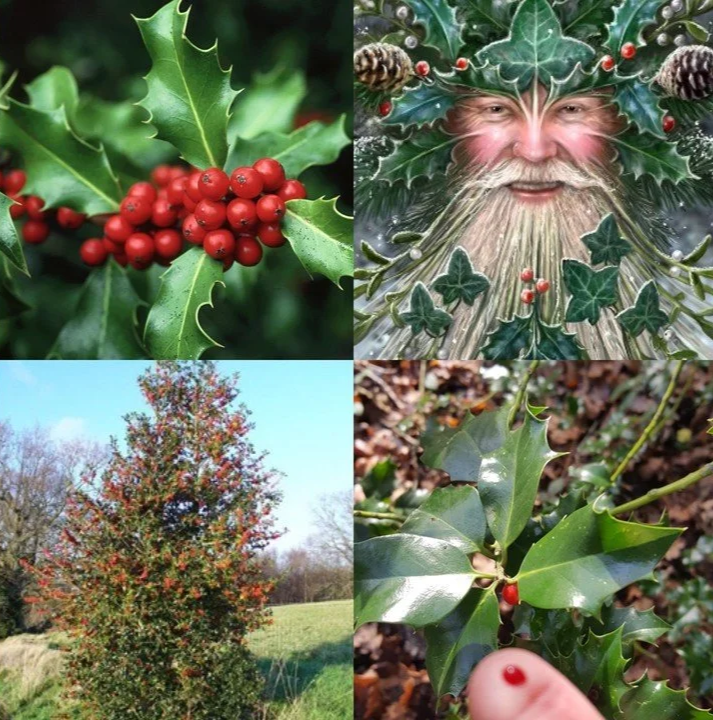
Walking with Holly
In the mists of Celtic mythology, the crown of king of the forest is fought for between the Holly King and the Oak Kings. The story goes that the kings battle twice a year -at the summer and winter solstice, for the forest. The Holly takes the crown for the wintering months, the Oak as light returns.
Next month we will pass the baton on once again - to the Oak.
I hope you enjoyed this piece! Subscribe The Soul Shed on Substack to read the Olive piece and forthcoming Oak piece. For access to the full archive, and to support the research that goes into these posts, you might like to consider becoming a paid Subscriber.